AI in Publishing Industry: Benefits and Challenges for Authors and Publishers
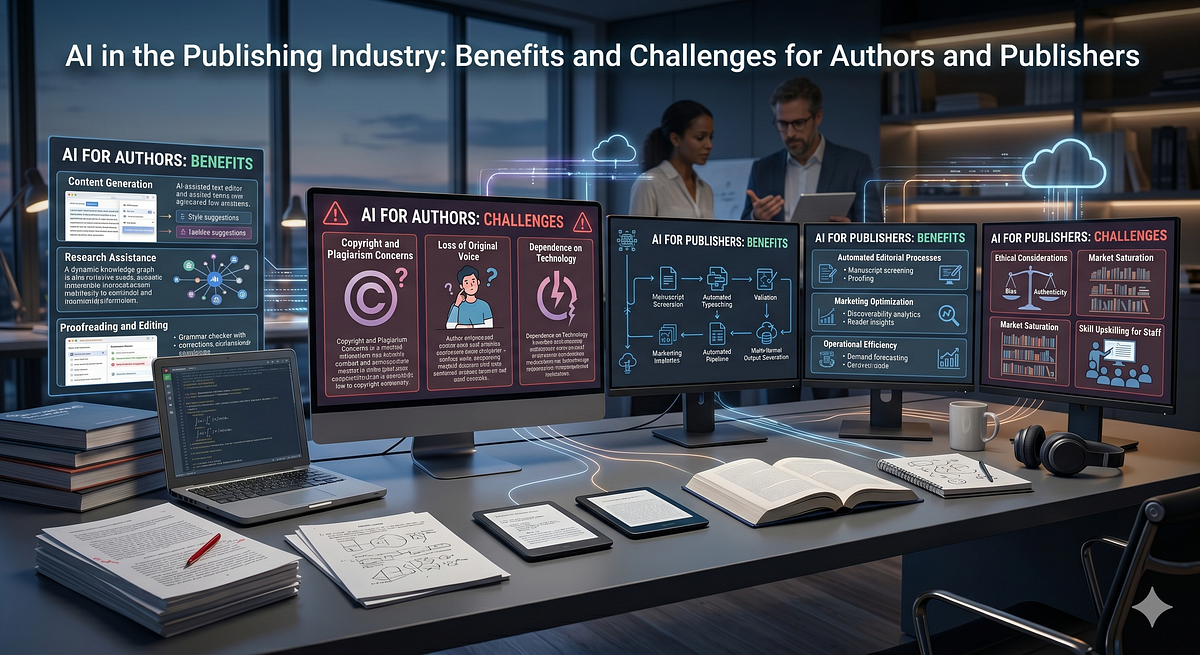
AI is reshaping publishing workflows faster than most teams have had time to evaluate what they are actually adopting. The benefits are real. So are the structural risks and confusing one for the other is where publishers are making costly decisions right now.
The publishing industry’s relationship with AI is not a future scenario. Research published in 2025 confirms that AI has already been integrated across the entire publishing value chain from manuscript development and peer review to production, accessibility, and distribution. Surveys from the Alliance of Independent Authors and Thomson Reuters both point to roughly 70% of publishing professionals already using AI tools in some capacity. The question is no longer whether to use AI. It is where AI strengthens your workflow and where it quietly degrades it.
Where AI genuinely improves publishing operations
AI delivers measurable gains in the stages of publishing that are repetitive, data-heavy, and rules-governed. These are not trivial areas; they consume a disproportionate share of production time and budget in most publisher workflows.
The areas where AI-assisted tools produce consistent, verifiable improvements include:
- Automated quality checks against schema validation rules catching structural XML errors, metadata gaps, and accessibility failures before they reach platform ingestion
- AI-assisted copyediting for grammar, consistency, and style conformance, which reduces first-pass editorial time without replacing substantive editorial judgment
- Metadata generation and enrichment assigning subject classifications, keywords, and ONIX fields at scale across large title catalogues
- Peer reviewer matching in STM journals, where AI can surface relevant, conflict-free reviewers from citation networks faster than manual methods
These applications share a common property: the output is verifiable. A schema validation check either passes or fails. A metadata field is either complete or it is not. AI works well when the success criterion is defined and the error is detectable.
AI in publishing earns its value when it automates what is measurable. It creates risk when it substitutes for what requires judgment.
Where the risks are being underestimated
The challenges that publishers are navigating with AI are not primarily technical. They are structural and editorial and they are easy to miss because the outputs often look correct even when they are not.
Generative AI is defined as AI that produces new content text, images, or data by drawing on patterns learned from training data. In a publishing context, this raises three issues that no workflow automation resolves on its own: authorship integrity and disclosure obligations, copyright exposure in AI-assisted content, and the erosion of editorial depth when AI-generated drafts replace genuine expert development.
Publishers working with the best publishing services have learned to treat these as workflow design problems, not technology problems. The answer is not to avoid AI, it is to define precisely which decisions belong to AI and which belong to editors, authors, and production specialists. Teams that draw that boundary explicitly produce better output than those that let the boundary drift with convenience.
What this means for publishers building their AI strategy now
Publishers working with Wordium on production automation have found that the most effective approach treats AI as an infrastructure layer rather than a replacement layer. AI handles validation, consistency checking, and metadata at scale. Editorial judgment, content development, accessibility compliance review, and author relationships remain human functions because those are where error is expensive and trust is built.
The publishers making the right AI decisions right now are not asking “how much can AI do?” They are asking “which outcomes require human accountability?” The answer to that second question determines where AI creates value and where it creates liability.
AI does not reduce the need for publishing expertise. It relocates where that expertise is most critical and raises the cost of not having it in the right places.
If integrating AI into your publishing workflow without compromising editorial quality or structural compliance is a challenge your team is working through, Wordium’s publishing specialists are happy to walk you through how others have solved it.


Comments
Post a Comment