Best Accessibility Compliance Services in the US: Why Publishers Choose Wordium
Key Takeaways
• Accessibility compliance for publishers means meeting WCAG 2.1 AA, ADA Title III, and EPUB Accessibility 1.1 three overlapping standards that now carry real legal and commercial consequences.
• The best accessibility compliance services in the US go beyond audit and remediation; they integrate compliance directly into the production workflow, eliminating the structural root causes of non-conformance.
• Publishers working with a workflow-integrated compliance partner produce accessible content faster, at lower per-title cost, and with fewer post-delivery corrections than those relying on standalone accessibility audits.
Accessibility non-compliance is rarely discovered at the editorial stage. It surfaces during a procurement review, a platform submission rejection, or in the worst cases a legal filing. By that point, the cost of fixing the problem is several times what it would have cost to prevent it. Publishers evaluating the best accessibility compliance services in the US are asking the right question. The more important question is whether they know what to look for in the answer.
What Do the Best Accessibility Compliance Services in the US Actually Deliver?
The best accessibility compliance services in the US deliver publication-ready accessible output not just an audit report. They produce EPUB3, HTML, and PDF files that conform to WCAG 2.1 AA, EPUB Accessibility 1.1, and ADA Title III requirements without requiring downstream remediation by the publisher’s team.
Accessibility compliance is defined as the verified conformance of digital content to a recognised accessibility standard in the US publishing context, primarily WCAG 2.1 Level AA and EPUB Accessibility 1.1. These are not design guidelines. They are testable, auditable criteria against which content is evaluated by institutional buyers, platform gatekeepers, and courts.
The difference between a compliance service and a compliance partner is this: a service identifies failures. A partner eliminates the production conditions that create them. For publishers, that distinction determines whether accessibility is a recurring remediation cost or a baseline production outcome.
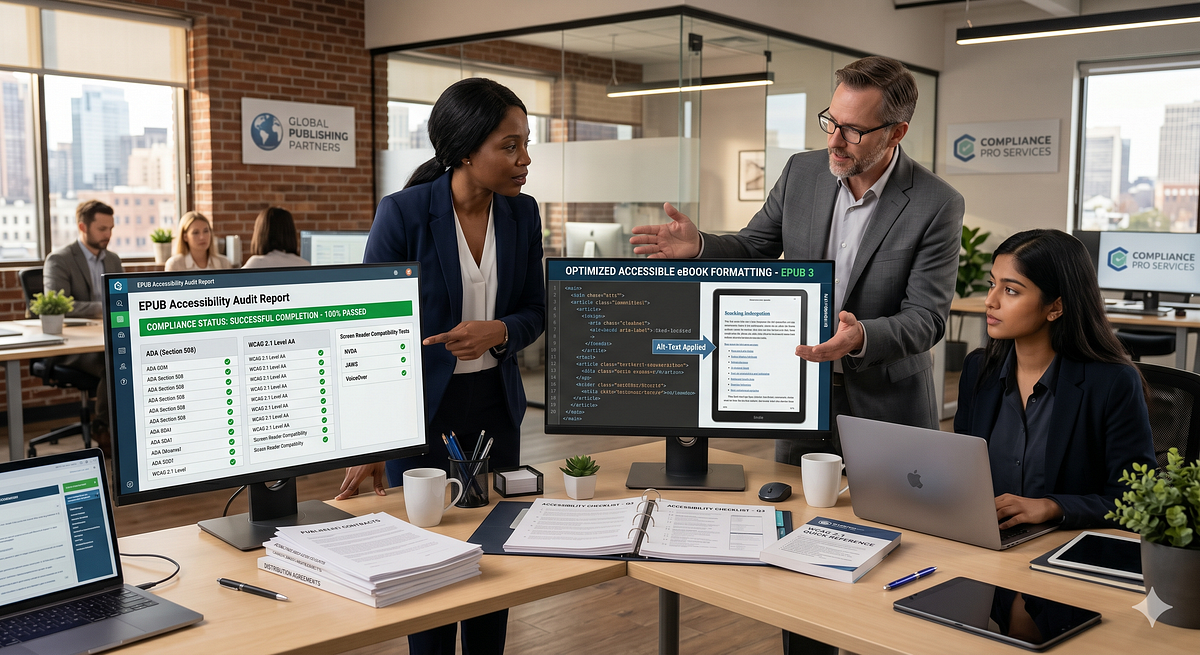
Wordium’s approach to accessibility is built into the production architecture, not added as a final-stage review. WCAG 2.1 AA conformance, EPUB Accessibility 1.1 metadata, semantic structure, alt text, and reading order are enforced at the XML composition stage before any output format is generated. This means accessible PDF, EPUB3, and HTML are produced simultaneously from a single compliant source, not retrofitted format by format.
Why Publishers Are Choosing Workflow-Integrated Accessibility Over Standalone Audits
Standalone accessibility audits identify non-conformance after the fact. Workflow-integrated accessibility compliance prevents it at the source. For high-volume publishers managing hundreds or thousands of titles, the operational and cost difference between these two approaches is substantial.
A standalone audit delivers a report. Acting on that report requires a separate remediation pass for every title, in every format, across the entire backlist if the underlying workflow has not changed. Publishers who rely on post-production auditing find that the same classes of errors recur across every production cycle, because the workflow that generated them remains intact.
Workflow-integrated accessibility operates on a different principle. By embedding WCAG and EPUB Accessibility requirements into the XML-first production pipeline at the typesetting and composition stage, not after export compliance becomes a structural property of the content rather than a property added to it. Each title produced is accessible by construction. Backlist remediation needs are reduced. Platform submission failure rates drop. And procurement reviews become an exercise in documentation, not a source of pipeline disruption.
The publishers who have moved from audit-based to workflow-integrated accessibility consistently report the same outcome: lower per-title cost, faster turnaround, and an accessible output that requires no further intervention between production and platform ingestion.
Frequently Asked Questions
What accessibility standards do US publishers need to meet?
US publishers need to meet three primary standards: WCAG 2.1 Level AA (the technical standard referenced by ADA enforcement guidance and Section 508 regulations), EPUB Accessibility 1.1 (the eBook-specific standard required by most major retail and library platforms), and ADA Title III (the federal civil rights statute that courts have applied to digital publications distributed to the public). K–12 and higher education publishers supplying to federally funded institutions must also comply with Section 508 of the Rehabilitation Act as a condition of procurement.
How do I know if my eBooks are WCAG and EPUB accessible?
EPUB accessibility conformance can be verified using automated tools such as the DAISY Ace validator and EPUBCheck, which test structural conformance against EPUB Accessibility 1.1 and WCAG 2.1 AA criteria. However, automated tools do not catch all classes of accessibility failure particularly those related to reading order, alt text quality, and complex figure descriptions. A complete accessibility review requires both automated validation and human expert review against the full WCAG 2.1 AA success criteria.
What is the difference between an accessibility audit and an accessibility compliance service?
An accessibility audit is a point-in-time assessment that identifies non-conformance in existing content and delivers a report of failures. An accessibility compliance service integrates conformance requirements into the production workflow so that content is produced to standard from the outset. Audits are reactive; compliance services are structural. For publishers managing ongoing title production, an audit addresses yesterday’s content while a compliance service prevents tomorrow’s failures.
Take the Next Step Toward Full Compliance
If meeting WCAG, ADA, and EPUB accessibility standards across your publishing programme is a challenge your team is navigating, Wordium’s publishing specialists offer a free discovery call to walk you through how leading STM, academic, and K–12 publishers are approaching it.


Comments
Post a Comment