How to Choose an Outsourcing Partner for Academic Book Production in Canada
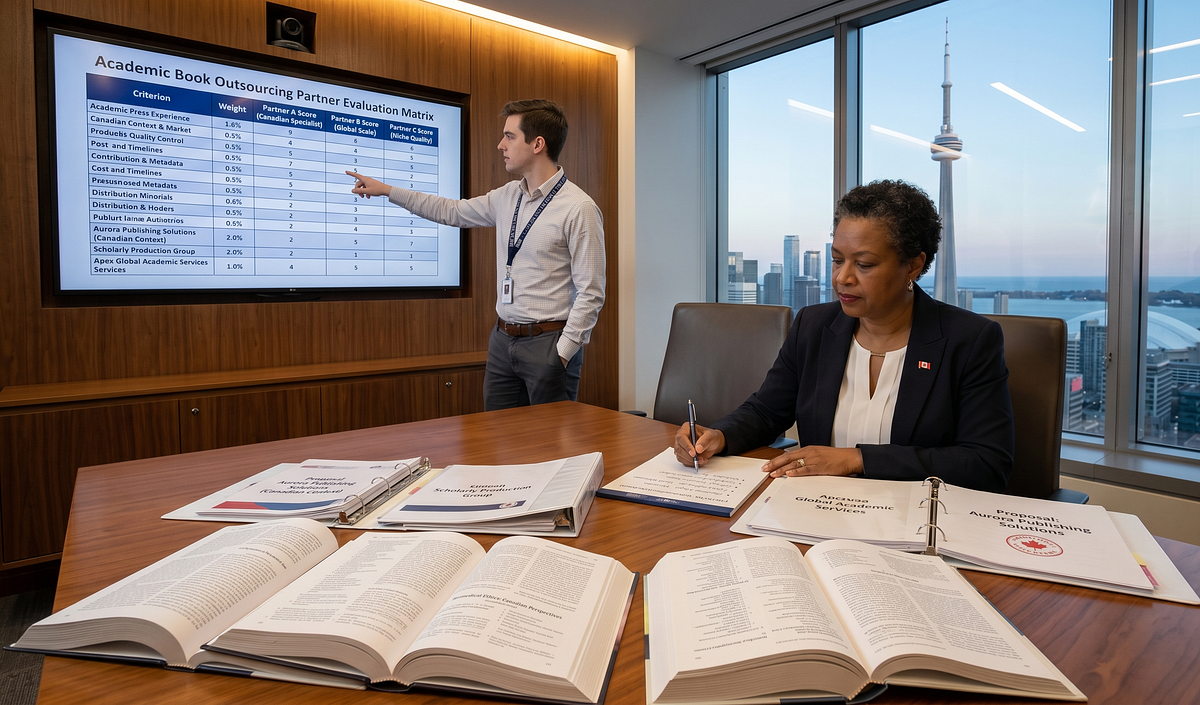
Canadian academic publishers are under more pressure than usual right now. The ADA Title II deadline in April 2026 means accessibility can’t be an afterthought, production timelines keep tightening, and budgets aren’t growing to match. For publishers considering outsourcing book production for the first time, or rethinking an existing vendor relationship, here’s what actually separates a reliable partner from a risky one.
Can they handle the full pipeline, not just one piece of it? Copyediting, typesetting, XML conversion, and accessibility output are usually treated as separate vendor relationships, which means every handoff between them is a place where something gets missed. The publishers with the smoothest production cycles work with a partner who runs all of it as one workflow, so accessibility metadata gets built alongside the XML, not bolted on six months later. This is exactly how we’ve structured our production process, because we’ve seen what happens when it isn’t.
Do they actually understand accessibility, or just check a box? With ADA Title II approaching, “we can add alt text” isn’t the same as “we understand WCAG 2.1 AA, EPUB3 structure, and the metadata that makes accessibility discoverable to procurement systems.” A partner who treats accessibility as a structural part of production, not a final pass, is the one whose output will actually hold up under audit. We built our accessibility work around this distinction specifically, because it’s the gap we see most publishers fall into.
Can they scale without your quality dropping? A small batch goes fine. The real test is what happens when a backlist needs remediation, or a journal program adds three new titles in a quarter. Capacity that doesn’t come at the cost of consistency is rarer than it sounds, and it’s the reason we built our teams around standardized, repeatable workflows rather than one-off project handling.
Is the cost advantage real, or does it disappear into rework? India-based production offers a genuine 40–60% cost advantage over Western in-house costs, but only if the quality holds. Otherwise the savings get eaten by revisions and delays. The publishers we work with stay with us because the first project doesn’t need three rounds of fixes, it’s why 66% of US and UK publishers already prefer India for this work, and it’s the same trust we aim to earn with every new Canadian publisher we start working with.
If you’re evaluating partners against this list, Wordium is built around exactly these four points, full-pipeline production, accessibility done right the first time, scalable capacity, and pricing that holds up because the work doesn’t need redoing. Get in touch to talk through your current production setup and where the gaps might be.
Wordium provides full-service academic book production, copyediting, typesetting, XML/EPUB conversion, and WCAG-compliant accessibility, for Canadian and North American academic publishers.


Comments
Post a Comment