From PDF to XML: What Publishers Lose and Gain in Conversion
From PDF to XML: What Publishers Lose and Gain in Conversion
From PDF to XML: What Publishers Lose and Gain in Conversion
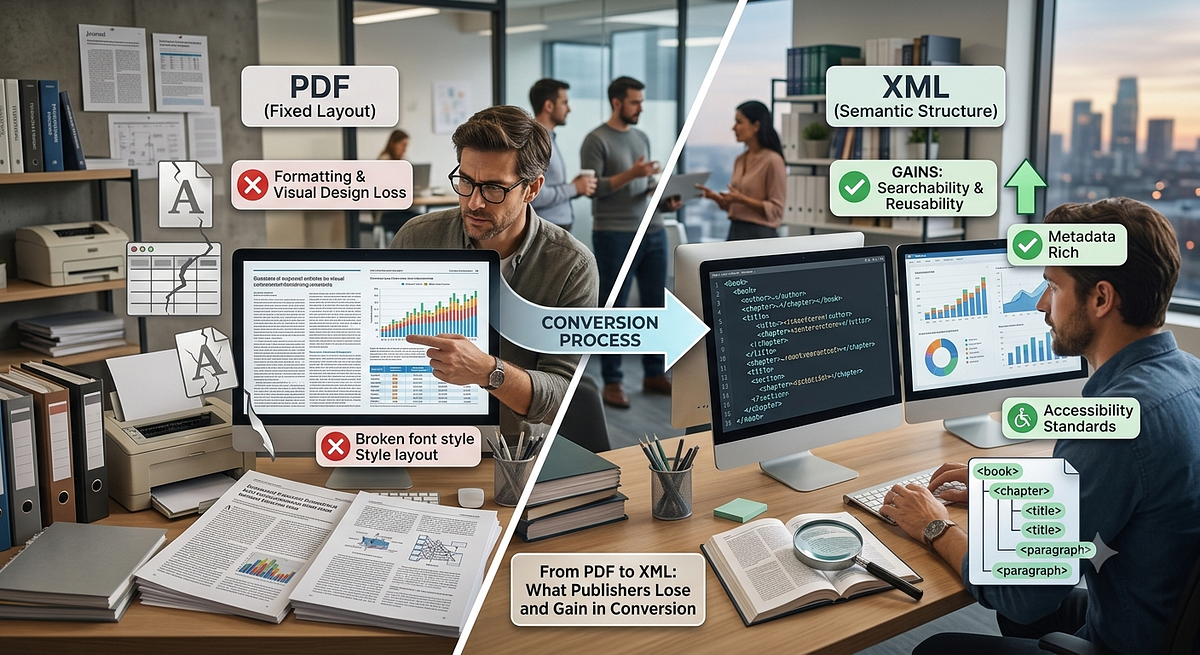
For decades, PDFs have been the industry standard for sharing and archiving content. While they preserve layouts and ensure consistency across devices, modern publishing demands more than static documents. As publishers transition toward XML-first workflows, understanding what is lost and gained during PDF-to-XML conversion becomes essential for long-term scalability.
What Publishers Lose During PDF-to-XML Conversion
PDFs are designed for presentation, not content intelligence. Converting them into XML often means moving away from fixed layouts and visual formatting.
Publishers may lose:
- Exact page-based formatting and typography.
- Manual design elements embedded within the document.
- Static structures that are difficult to adapt across platforms.
- Legacy workflows built around print-first production.
Complex elements such as tables, equations, footnotes, and multi-column layouts also require careful extraction to preserve content integrity. Without a structured conversion strategy, publishers risk introducing inconsistencies into their digital assets.
However, these short-term challenges are often outweighed by the long-term advantages of XML.
What Publishers Gain with XML Conversion
XML transforms content into structured, machine-readable data that can be reused across multiple publishing channels. Rather than recreating content for every format, publishers can maintain a single source of truth.
Key benefits include:
- Faster multi-format publishing for EPUB, HTML, and PDF.
- Improved metadata management and discoverability.
- Better support for accessibility standards and regulatory compliance.
- Easier integration with content management systems.
- Automated workflows that reduce manual intervention.
- Enhanced search engine visibility and AI-readability.
For STM, academic, and educational publishers managing large content volumes, XML enables scalable production pipelines and future-ready publishing ecosystems.
Explore Wordium’s /xml-conversion-services and /digital-conversion-solutions to learn how structured workflows improve publishing efficiency.
Why XML Is Becoming Essential
Search engines, AI systems, and digital platforms increasingly rely on structured content to understand and surface information. XML provides the semantic framework needed for better indexing, content reuse, and long-term preservation.
Combined with editorial, typesetting, and accessibility workflows, XML allows publishers to move beyond static documents and build agile publishing operations.
Discover Wordium’s services or visit /contact-us to discuss your conversion requirements.


Comments
Post a Comment