When to Use LaTeX vs InDesign for STM Content
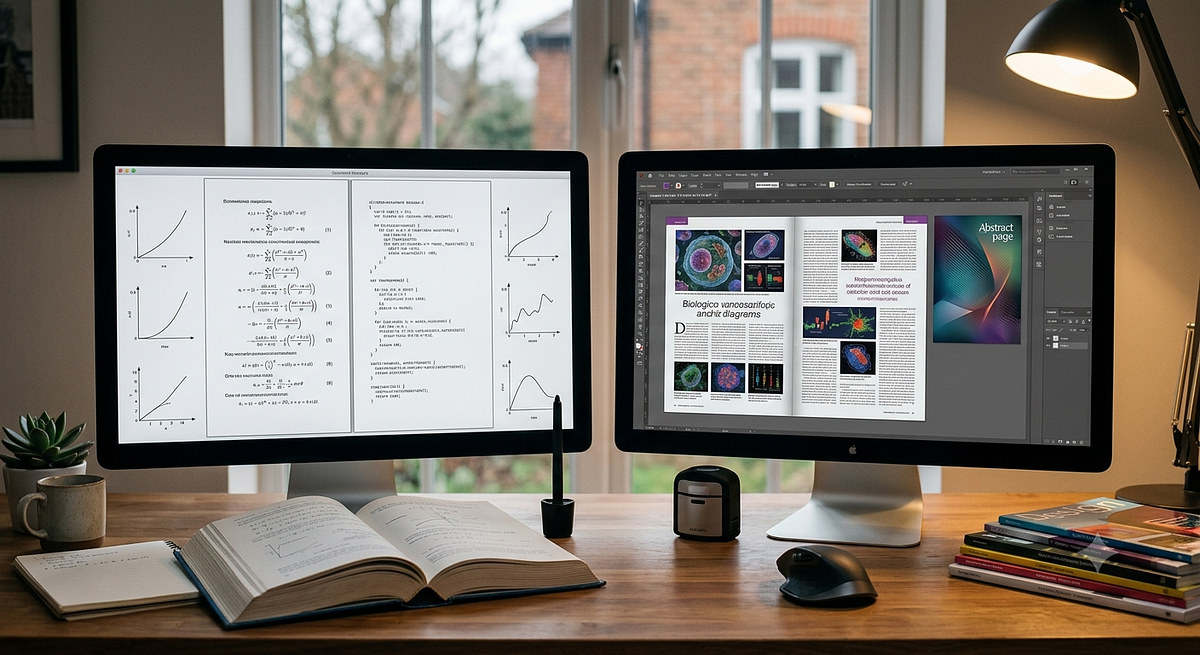
Scientific, Technical, and Medical (STM) publishing demands precision, consistency, and scalability. Choosing between LaTeX and Adobe InDesign is not simply a design decision; it directly impacts production efficiency, content accuracy, and publishing timelines. Understanding where each platform excels helps publishers build smarter workflows.
LaTeX: The Standard for Complex Scientific Publishing
LaTeX is widely used in academic and research publishing because it handles highly structured content with ease. Journals and textbooks containing mathematical equations, chemical formulas, tables, citations, and cross-references benefit significantly from LaTeX-based workflows.
LaTeX is ideal when your publication includes:
- Mathematical and statistical equations.
- Research papers and journal articles.
- Technical books with extensive references.
- Automated citation and bibliography management.
- XML-first and digital-first publishing workflows.
For STM publishers managing large volumes of scholarly content, LaTeX ensures consistency across chapters while reducing manual formatting errors.
Related services: Explore Wordium’s XML and digital publishing capabilities at /xml-conversion-services and /digital-conversion-solutions.
InDesign: Best for Visually Rich Publications
Adobe InDesign excels when layout flexibility and visual storytelling take priority. Educational publishers, medical manuals, and technical training materials often rely on InDesign to create engaging page designs.
InDesign is the preferred choice for:
- Textbooks with heavy visual elements.
- Interactive eBooks and training materials.
- Marketing collateral and reports.
- Custom layouts requiring precise typography.
- Publications with illustrations, infographics, and complex page compositions.
However, manually handling equations and references in InDesign can become resource-intensive for large-scale STM projects.
The Smarter Approach: Combining Both Tools
Modern publishers increasingly adopt hybrid workflows that leverage LaTeX for content structuring and InDesign for final design refinement. This approach improves production speed, ensures technical accuracy, and supports multi-format outputs such as EPUB, PDF, and accessible digital content.
To streamline your publishing workflow, explore Wordium’s typesetting-services.
Looking to optimize your STM production pipeline? Visit /contact-us to discover how Wordium helps publishers deliver accurate, scalable, and future-ready content.


Comments
Post a Comment